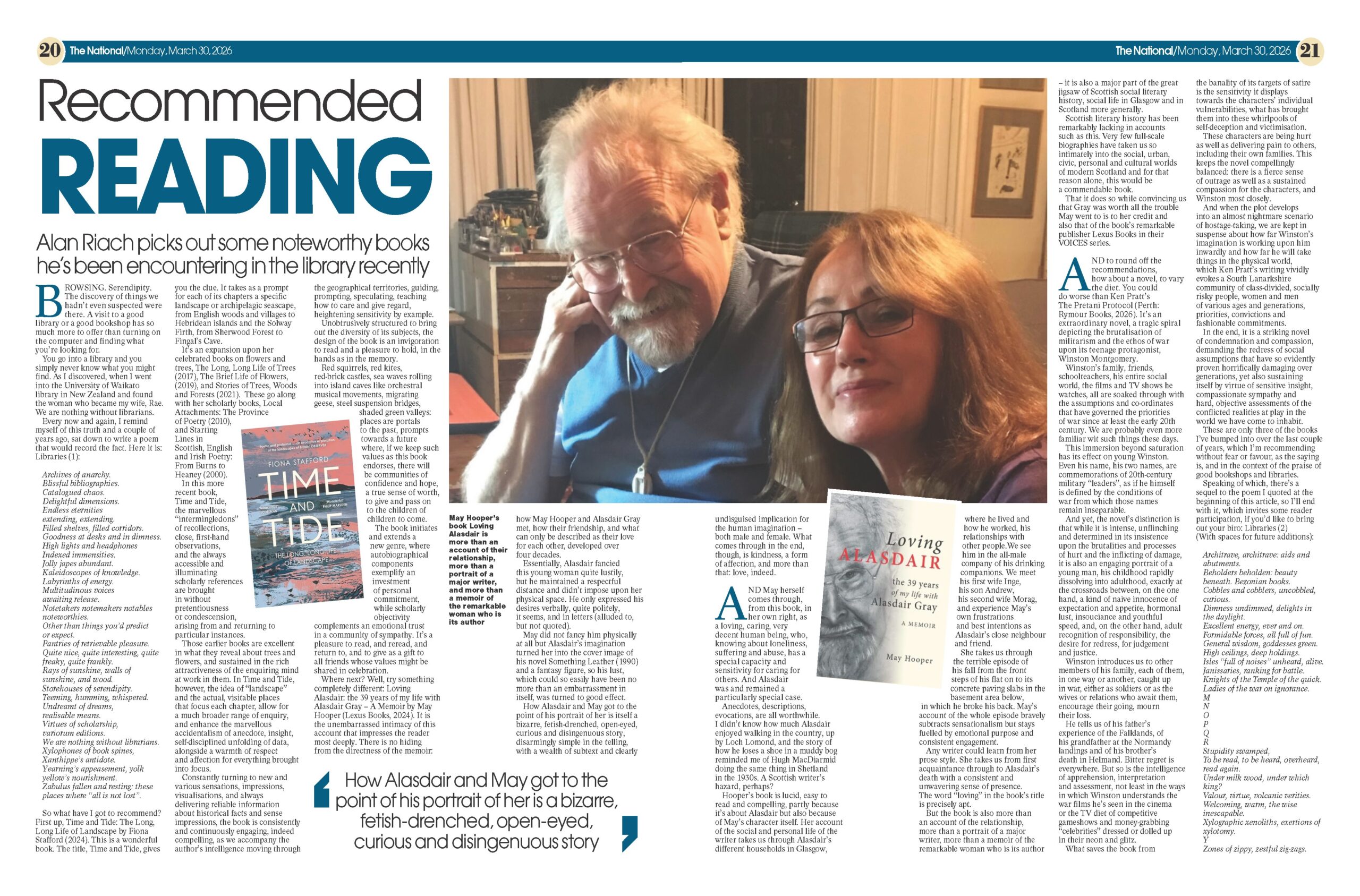
Alan Riach, writing in The National, recommends Loving Alasdair.
“It is the unembarrassed intimacy of this account that impresses the reader most deeply. There is no hiding from the directness of the memoir: how May Hooper and Alasdair Gray met, how their friendship, and what can only be described as their love for each other, developed over
four decades.
Essentially, Alasdair fancied this young woman quite lustily, but he maintained a respectful distance and didn’t impose upon her physical space. He only expressed his desires verbally, quite politely, it seems, and in letters (alluded to, but not quoted).
May did not fancy him physically at all but Alasdair’s imagination turned her into the cover image of his novel Something Leather (1990) and a fantasy figure, so his lust, which could so easily have been no more than an embarrassment in itself, was turned to good effect. How Alasdair and May got to the point of his portrait of her is itself a bizarre, fetish-drenched, open-eyed, curious and disingenuous story, disarmingly simple in the telling, with a wealth of subtext and clearly undisguised implication for the human imagination – both male and female. What comes through in the end, though, is kindness, a form of affection, and more than that: love, indeed.
And May herself comes through, from this book, in her own right, as a loving, caring, very decent human being, who, knowing about loneliness, suffering and abuse, has a special capacity and sensitivity for caring for others. And Alasdair was and remained a particularly special case. Anecdotes, descriptions, evocations, are all worthwhile. I didn’t know how much Alasdair enjoyed walking in the country, up by Loch Lomond, and the story of how he loses a shoe in a muddy bog reminded me of Hugh MacDiarmid doing the same thing in Shetland in the 1930s. A Scottish writer’s hazard, perhaps?
Hooper’s book is lucid, easy to read and compelling, partly because it’s about Alasdair but also because of May’s character itself. Her account of the social and personal life of the writer takes us through Alasdair’s different households in Glasgow, where he lived and how he worked, his relationships with other people. We see him in the all-male company of his drinking companions. We meet his first wife Inge, his son Andrew, his second wife Morag, and experience May’s own frustrations and best intentions as Alasdair’s close neighbour and friend.
She takes us through the terrible episode of his fall from the front steps of his flat on to its concrete paving slabs in the basement area below, in which he broke his back. May’s account of the whole episode bravely subtracts sensationalism but stays fuelled by emotional purpose and consistent engagement.
Any writer could learn from her prose style. She takes us from first acquaintance through to Alasdair’s death with a consistent and unwavering sense of presence. The word “loving” in the book’s title is precisely apt.
But the book is also more than an account of the relationship, more than a portrait of a major writer, more than a memoir of the remarkable woman who is its author – it is also a major part of the great jigsaw of Scottish social literary history, social life in Glasgow and in Scotland more generally.
Scottish literary history has been remarkably lacking in accounts such as this. Very few full-scale biographies have taken us so intimately into the social, urban, civic, personal and cultural worlds of modern Scotland and for that reason alone, this would be a commendable book.
That it does so while convincing us that Gray was worth all the trouble May went to is to her credit and also that of the book’s remarkable publisher Lexus Books in their VOICES series.”
Read the full article here – Three noteworthy books I’ve encountered in the library | The National



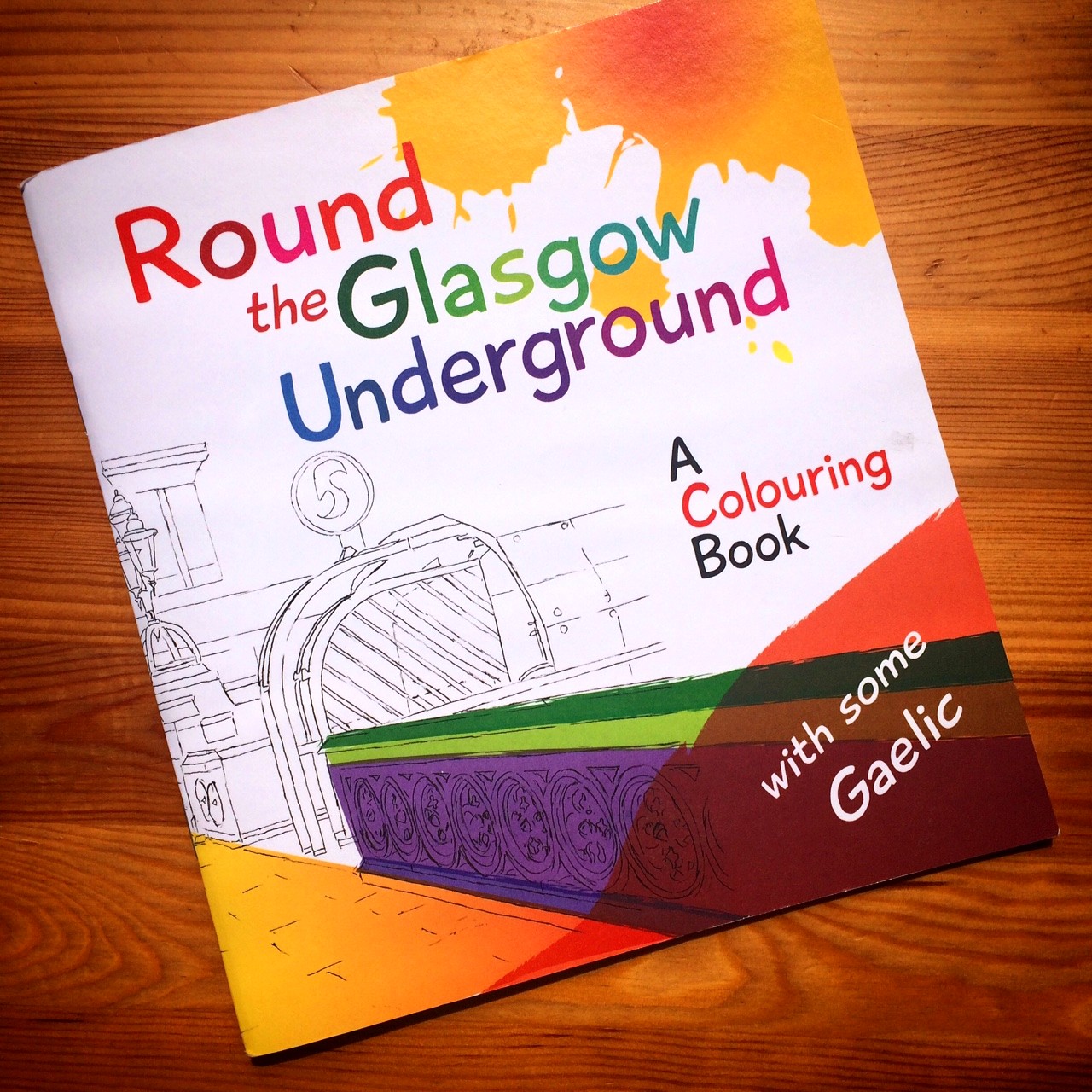 We’re really happy to be donating a box of our Round the Glasgow Underground colouring books to the Urban Fox Programme!